The Competence Paradox: When Measuring Skills Freezes Them in Time
Competence-based systems promise certainty in an uncertain world. They reassure regulators, employers, and learners that skills can be defined, measured, and verified. If someone is declared competent, the logic is simple: they are ready for work, the risk is managed, and the system has done its job.
But what if that confidence is misplaced?
In modern workplaces shaped by automation, digital controls, and procedural safeguards, performing tasks is rarely the hardest part of the job. Machines guide actions. Software flags errors. Systems catch mistakes before humans do. What differentiates people is no longer whether they can follow a procedure, but how they behave when the procedure no longer fits the situation.
This is the paradox at the heart of competence-based thinking. The more precisely we define and measure tasks, the easier it becomes to miss the qualities that actually determine safe, reliable, and professional performance: judgement, restraint, responsibility, and the ability to pause, escalate, or refuse when conditions change.
Competence frameworks were designed to verify what people can do. Modern work increasingly depends on how people choose to act. When skill is treated as something that can be captured at a single moment in time, systems risk freezing performance in place while real work continues to evolve around it.
Competence may still be necessary. But on its own, it is no longer enough.
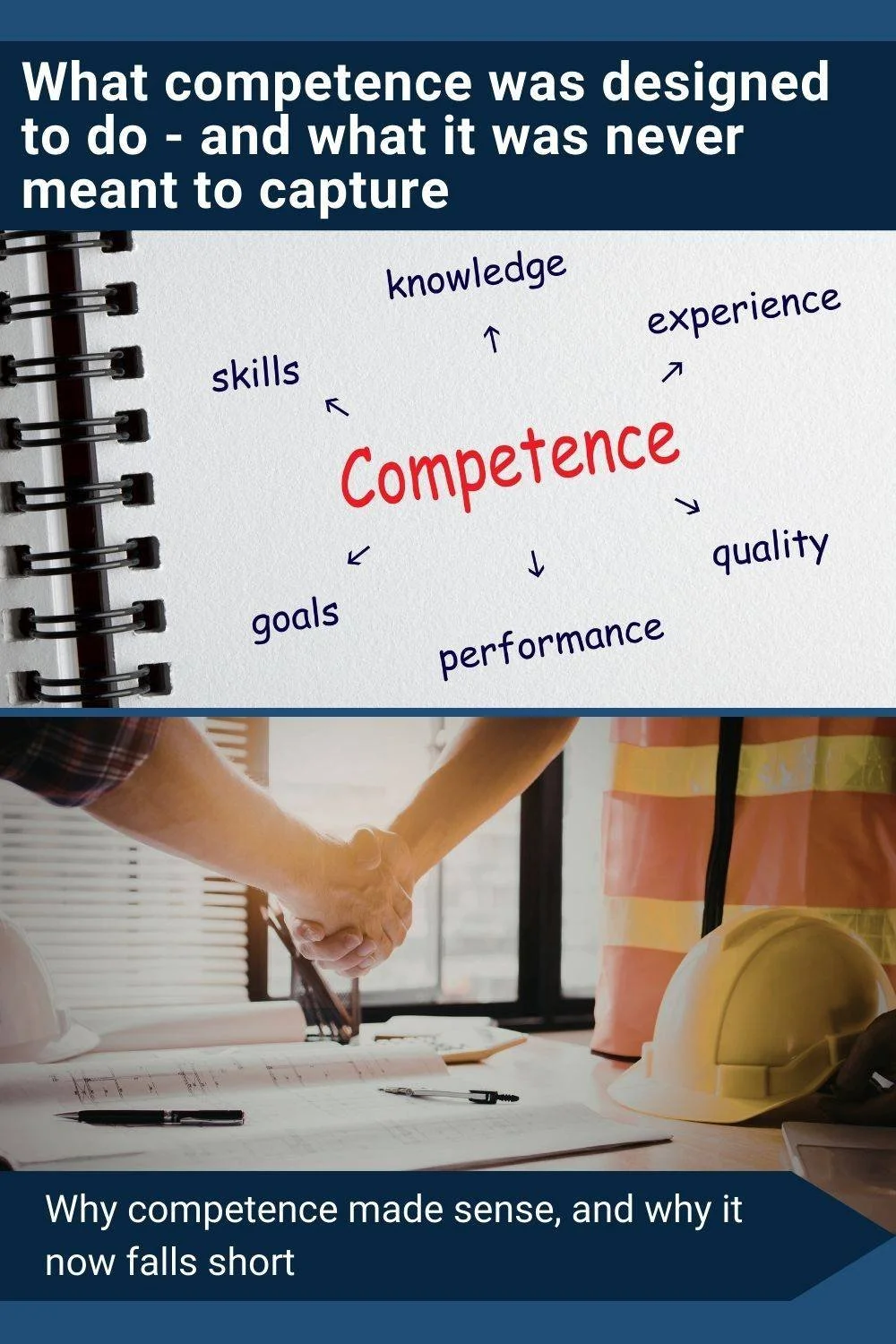
What competence was designed to do - and what it was never meant to capture
Competence-based frameworks did not emerge by accident, nor were they poorly conceived. They were created to address real weaknesses in education and training systems built on vague qualifications, inconsistent assessment, and weak labour-market signals. At their best, competence brought clarity, structure, and defensibility where there had previously been assumption.
Their purpose was deliberately narrow. Competence was designed to answer a specific question: Can this person perform a defined task to an agreed standard under specified conditions? By focusing on observable performance, competence frameworks reduced arbitrariness and created a shared language for regulators, employers, and providers. In many contexts, this was a genuine advance.
This is why competence works well for craft skills and manual tasks. Where work is stable, tasks are repeatable, and correct execution can be clearly specified, competence statements are effective. Expectations are explicit, assessment is fair, and certification is defensible. In such settings, the limits of competence remain largely invisible because the work itself fits the model.
The problem is not that competence fails. It is that it has been stretched beyond its original purpose.
Competence was never designed to capture autonomy, judgement, responsibility, or professional behaviour. These qualities do not sit comfortably in checklists. They are context-dependent, revealed over time, and often only visible when something goes wrong. Although modern standards increasingly reference authorised limits, escalation, and safe response, these additions manage risk rather than redefine what competence fundamentally measures.
As work shifts from isolated task execution to system-based operation, this gap becomes impossible to ignore. Operators, technicians, and professionals rarely succeed or fail solely because of whether they can perform a task. Their value lies in how they respond to uncertainty, exercise restraint, and behave under pressure, precisely the dimensions that task-focused competence struggles to capture without relying on weak proxies.
The result is a growing mismatch between what competence frameworks claim to measure and what modern work actually demands. This is not a failure of implementation. It is the predictable outcome of applying a task-based model to roles shaped as much by judgement and responsibility as by technical skill.
The illusion of objectivity: why competence feels precise but isn’t
Competence-based systems are designed to look objective. Tasks are defined, criteria are written, evidence is specified, and decisions are recorded. Compared with informal judgement, this appears rigorous, fair, and defensible. It is easy to see why competence became the language of regulation.
But precision is not objectivity.
Judgement sits at every point in a competence-based system. Someone decides what “good enough” looks like, how strictly procedures should be applied, and which evidence counts. Two assessors can apply the same standard and reach different conclusions while both remain fully compliant. The framework does not remove judgement; it structures where it sits.
Observation itself is not neutral. What an assessor notices or tolerates is shaped by experience, organisational culture, and risk appetite. One assessor may accept adaptive behaviour that achieves safe outcomes. Another may insist on strict procedural compliance. Both are assessing competence, but they are not assessing the same thing.
Binary decisions reinforce the illusion. Individuals are judged as competent or not yet competent, even though real performance sits on a spectrum. Someone may be safe but slow, efficient but reckless, technically correct but poor at escalation. Compressing this complexity into a single outcome simplifies administration, but conceals what actually matters.
Because judgement, autonomy, and responsibility are difficult to assess directly, competence frameworks rely on proxies. Phrases such as “works independently” or “takes corrective action” stand in for deeper qualities that only reveal themselves over time and under pressure. These proxies are convenient, but weak.
Competence endures not because it is objective, but because it is defensible. Regulators need audit trails. Assessors need anchors. Systems need comparability. Competence provides these by stabilising judgement rather than eliminating it.
The real risk is not that competence involves judgement. The risk is that systems deny it. When assessment outcomes are presented as purely technical and objective, they invite misplaced confidence in measures that are precise in form, but partial in what they capture.

From tasks to trust: how competence quietly became about behaviour
Although competence frameworks still present themselves as task-focused, their language tells a different story. Look closely at modern standards and assessment criteria and a pattern emerges. The emphasis is no longer just on whether a task can be performed, but on how it is performed, within what limits, and with what response when conditions change.
Terms such as authorised limits, escalation, safe response, compliance, and approved methods appear repeatedly across sectors. These are not measures of technical skill. They are signals of behavioural reliability. They ask whether someone can recognise uncertainty, stay within authority, and act responsibly when the situation no longer follows the script.
This marks a quiet but significant shift. The central question has moved from “Can you do X?” to “Do you behave appropriately while doing X?” In complex, safety-critical environments, this is the question that actually matters. Serious failures rarely stem from a lack of skill. They arise when people overstep authority, delay escalation, ignore weak signals, or trade safety for speed and convenience.
Competence frameworks have adapted to this reality, but indirectly. Because judgement, autonomy, and responsibility are difficult to assess explicitly, systems embed them into task statements as proxies. Phrases such as “works independently” or “takes corrective action” stand in for deeper qualities that only reveal themselves over time and under pressure. Judgement appears to be assessed, but is in fact inferred.
Here the paradox sharpens. The more frameworks try to regulate behaviour through task language, the further they drift from what they are actually trying to control. Trustworthiness is not demonstrated through flawless execution in controlled conditions, but through consistent behaviour under ambiguity, pressure, and competing demands. Someone may meet every competence statement and still be unsafe or unreliable. Another may fail parts of a checklist yet be calm, trusted, and operationally excellent.
Seen this way, competence is no longer best understood as a list of tasks. It functions as a set of trust boundaries: defining what someone may do independently, when they must escalate, and how they are expected to behave within systems designed to manage risk. Organisations already operate this way in practice. What remains missing is an explicit acknowledgement of this shift in how competence is defined, assessed, and governed.
Competence, autonomy, responsibility, and behaviour: judgements we keep collapsing into one
Most competence-based systems ask a single question and expect it to do too much work. When someone is declared “competent”, systems quietly assume four things at once: that the person can perform tasks, exercise sound judgement, act responsibly, and be trusted to operate independently. In reality, these are four distinct judgements, each with different implications for risk, accountability, and professional practice.
Competence tells us what a person can do. It is about capability: whether someone has demonstrated the technical ability to perform defined tasks to an agreed standard. This remains essential, particularly at entry points and in roles where basic procedural correctness matters. But competence alone tells us nothing about how that capability will be used.
Autonomy tells us what a person is allowed to decide. It defines the boundaries within which someone may act independently, adapt procedures, or make operational choices without supervision. Autonomy is not granted by skill alone. It reflects trust, exposure to risk, and the maturity of judgement required in a role. Two people with identical competence may legitimately be given very different levels of autonomy.
Responsibility tells us what a person is accountable for. It clarifies who carries the consequences of decisions, actions, and omissions. Responsibility is shaped by role, authority, and context, not just technical ability. Yet competence frameworks often imply responsibility without stating it explicitly, leaving accountability unclear when things go wrong.
Behaviour tells us whether a person should be trusted. It appears in judgement under uncertainty, ethical restraint, situational awareness, escalation behaviour, and consistency over time. Behaviour is rarely revealed through one-off task performance. It emerges through patterns, especially in non-routine and high-pressure situations. This is the dimension most closely tied to safety and reliability.
When systems collapse these four judgements into a single competence decision, they simplify assessment but distort meaning. Capability is mistaken for authority, certification for trust, and performance for accountability. This compression may be administratively convenient, but it becomes increasingly fragile as work grows more complex, automated, and risk-sensitive.
Making these distinctions explicit does not weaken competence-based systems. It strengthens them. It allows competence to remain a foundation rather than a proxy for everything else, and creates space for autonomy, responsibility, and behaviour to be recognised and governed directly, instead of being smuggled into task statements where they cannot be properly assessed.

Why competence must be demonstrated over time, not at a moment
Most competence-based systems assess performance at a single point in time. An observation is made, evidence is reviewed, a decision is recorded, and the individual is deemed competent. The system moves on. This episodic logic is efficient and auditable, but it sits uneasily with how real work actually unfolds.
Judgement, responsibility, and professional behaviour are not momentary qualities. They are revealed through patterns. A one-off assessment may show that someone can follow a procedure, but it says little about how they behave when conditions deteriorate, priorities clash, or pressure rises. Trustworthiness is not demonstrated in a snapshot. It is demonstrated in consistency.
This is why competence assessment often feels misaligned in complex roles. Operators, technicians, and professionals rarely fail because they lack technical knowledge. Failures more often stem from delayed escalation, overconfidence, silent deviation from procedures, or ethical shortcuts taken under pressure. These behaviours are unlikely to surface in planned assessments, particularly when individuals know they are being observed.
Time matters because it exposes what checklists cannot. It shows whether authorised limits are respected in practice, whether uncertainty is acknowledged or concealed, and whether safety is prioritised consistently rather than performatively. None of this can be reliably inferred from a single demonstration of task performance.
The problem is especially visible in recognition of prior learning and workplace-based certification. Some candidates struggle to evidence competence despite being trusted by supervisors and peers. Others assemble convincing portfolios without ever having been tested in genuinely demanding situations. The issue is not dishonesty. It is that the assessment model rewards artefacts rather than behaviour over time.
If competence is understood as a boundary of trust rather than a checklist of tasks, then time becomes central rather than incidental. Demonstration over time allows systems to observe restraint, escalation, learning from error, and response to feedback. It mirrors how organisations actually decide who can be trusted to operate independently, not just who can perform correctly when the moment is controlled.

From competence to entrustment: what medicine and aviation already do differently
Some sectors reached the limits of competence long before vocational education began to question it. In medicine and aviation, misplaced trust has immediate consequences. As a result, these fields moved beyond task-based competence towards models that explicitly recognise judgement, responsibility, and risk over time.
In these contexts, the key question is not whether someone can perform a task, but whether they can be trusted to perform it independently, safely, and consistently in real operational conditions. This is the logic of entrustment, where authority is granted deliberately and progressively rather than assumed at certification.
In medical education, this is formalised through Entrustable Professional Activities. Clinicians are judged not just on technical competence, but on repeated demonstrations of judgement, ethical behaviour, escalation, and situational awareness. Entrustment is contextual and conditional. Trust can increase, remain limited, or be withdrawn.
Aviation follows the same principle. Pilots are not certified once and left to operate indefinitely. Authority is bounded, behaviour is monitored, and autonomy grows only with demonstrated reliability over time. Recurrent training and simulation test judgement under pressure as much as technical skill. Certification enables participation. Entrustment enables autonomy.
What unites these models is a simple recognition: competence is necessary but insufficient. Skill establishes a baseline. Trust is earned through behaviour in context. Authority is explicit, not implied. Assessment is continuous rather than episodic.
Entrustment does not eliminate judgement. It accepts it and governs it transparently. Decisions are documented, reviewed, and revisable, rather than hidden behind checklists.
For vocational education and training, the relevance is clear. As work becomes more system-based, digital, and risk-sensitive, judgement, restraint, escalation behaviour, and ethical conduct matter more than flawless task execution. These qualities cannot be reliably captured through task lists alone, but they can be observed and evaluated over time.
The lesson is not that TVET should copy these sectors wholesale. It is that entrustment offers a language and logic that competence alone cannot, separating capability from authority, certification from trust, and skill from responsibility.
What this means for modern competence frameworks
If competence is understood as a boundary of trust rather than a checklist of tasks, the implications are significant but not disruptive. This is not a call to abandon competence-based systems. It is a call to recalibrate what they are expected to do.
First, competence statements should define trust boundaries, not task inventories. Rather than attempting to document every possible action, standards should clarify where independent operation is permitted, when escalation is required, and how uncertainty should be handled. This reflects how risk is actually managed in real organisations.
Second, autonomy and responsibility must be explicit, not implied. Many frameworks gesture towards these ideas through authorised limits or escalation language, but rarely define them clearly. Separating what someone can do from what they are allowed to decide and what they are accountable for reduces ambiguity and strengthens governance when things go wrong.
Third, assessment must extend beyond one-off demonstration to evidence over time. This does not imply continuous surveillance. It means structured observation across varied contexts, including non-routine situations, feedback cycles, and documented patterns of behaviour. In this model, competence is provisional and reaffirmed, not permanent and assumed.
Fourth, recognition of prior learning and workplace assessment should privilege trust signals over artefacts. Supervisor confidence, escalation behaviour, response to incidents, and consistency under pressure often reveal more about readiness than carefully assembled portfolios. Systems that ignore this risk certifying compliance rather than capability.
Finally, quality assurance must acknowledge judgement rather than deny it. The objective is not to eliminate subjectivity, but to govern it transparently. Clear expectations, shared criteria, peer review, and documented entrustment decisions provide greater integrity than the illusion of objectivity created by increasingly detailed checklists.
Taken together, these shifts do not weaken competence-based systems. They make them more honest, more aligned with real work, and better suited to occupations shaped by automation, digitalisation, and systemic risk.
Conclusion: competence as a floor, not a ceiling
In many ways, modern National Qualifications Frameworks already point in this direction. Their level descriptors increasingly recognise responsibility, autonomy, and judgement as defining features of occupational progression. The issue is not the frameworks themselves, but the persistence of assessment models that continue to treat competence as sufficient on its own.
Competence should remain. It provides a necessary assessment end point and a defensible baseline for certification. But competence does not operate in isolation. Real work is shaped by responsibility, autonomy, trust, and professional conduct, particularly in situations that demand judgement, creativity, problem-solving, and teamwork. These qualities do not fully reveal themselves at a single moment in time, even though assessment must occur at one.
The mistake is not assessing competence. The mistake is allowing competence alone to stand in for everything else.
As work becomes more automated, digital, and system-based, tasks become easier to perform while the consequences of poor judgement become more severe. What differentiates people is no longer whether they can follow procedures, but whether they know when to pause, escalate, adapt, or refuse.
Competence should define the floor. Responsibility, autonomy, trust, and professional conduct must define the ceiling. Systems that recognise this will be better equipped for the realities of modern work. Those that do not risk certifying certainty in a world that no longer behaves that way.
And if modern National Qualifications Frameworks are already pointing in this direction, a final question remains: is it not time the wider skills system followed?